Serbia's Incoming Government Confronts Old Economic Dilemmas With Russia and China
Serbia's next ruling majority faces looming deadlines on Russian-owned oil assets, Chinese-built projects and frozen European Union funds.
By Hassan Okoye ·
Serbia's next government will inherit a series of pressing economic deadlines tied to the country's longstanding relationships with Russia and China, from the fate of its Russian-owned oil industry to a Chinese-driven exhibition project and the prospect of unlocking European Union funding.
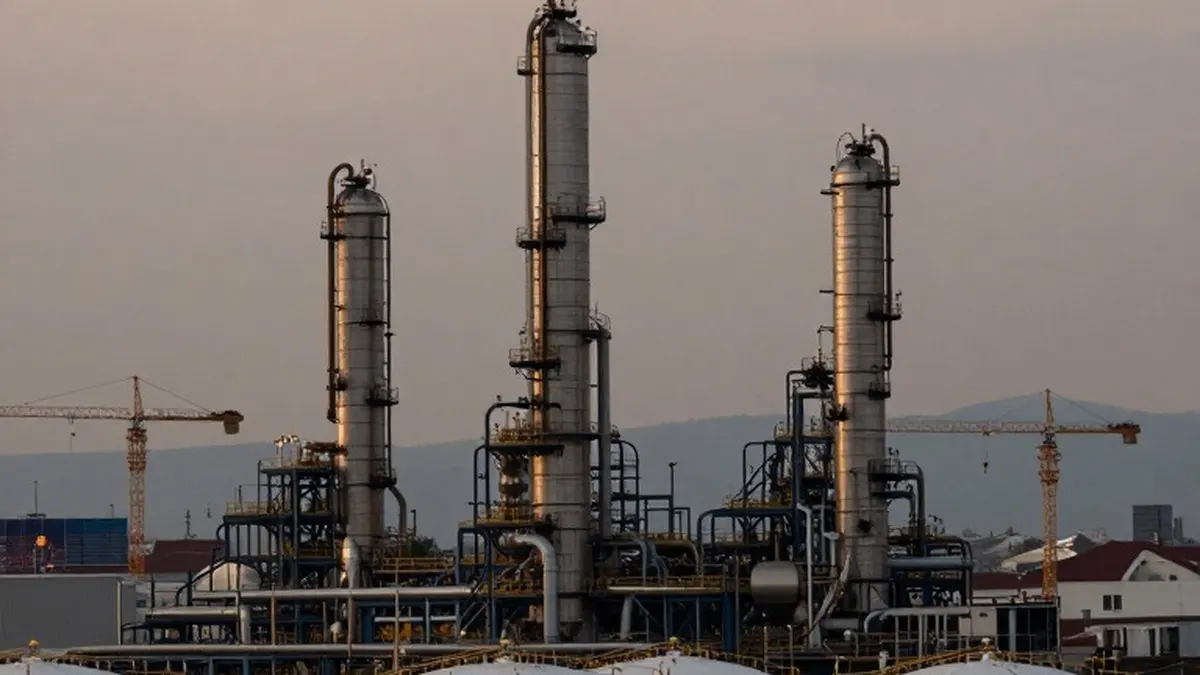
The Student List opposition movement won a landslide victory in last month's parliamentary election but has still not named its candidate for prime minister. Once in office, it will have little time to settle in. A US sanctions waiver covering NIS Group, which runs Serbia's only oil refinery, expires on December 11. Expo 2027 is due to open its doors in May, and the window for accessing payments from the EU's Growth Plan for the Western Balkans closes at the end of next year.
Washington imposed sanctions on NIS, which is majority-owned by Russian energy giant Gazprom, as part of punitive measures following Russia's 2022 full-scale invasion of Ukraine. The sanctions forced the company to suspend production last year until a series of waivers, starting in December, allowed it to continue activities while a deal was worked out for Gazprom to sell its stake to Hungarian energy company MOL.
"The Russians are still proving to be a very stubborn customer on this point, and they are not willing to give up that particular ownership," Vuk Vuksanovic, a foreign policy lecturer at King's College London, told RFE/RL. If the waiver is not extended, he said, it would be "a complete economic shock at the very start of the new government," describing the uncertainty as "a very dark cloud in the background."
Nikola Xaviereff, a research fellow at the German Council on Foreign Relations, told RFE/RL that "there will not be so many extensions" and that the "seismic change" of the US midterms would lead to more pressure from Washington to get the deal done quickly. On November 5, Hungarian Foreign Minister Anita Orban was quoted by local media as saying a deal could be completed by the December deadline.
Reliance on Russian gas is also entrenched, covering some 90 percent of Serbia's needs at bargain prices through a series of 3-month supply deals, with the current one expiring at the end of this year. The exact prices have not been disclosed, but former President Aleksandar Vucic claimed on social media that the latest deal cost 318 euros ($357) per 1,000 cubic liters, compared to market prices around the 900 euros mark. Student List leaders have indicated this dependency will not change anytime soon.
Under Vucic, the relationship with China was described as an "ironclad friendship," and the Student List has said it wishes to continue economic ties, but with transparency on contracts and open tendering. Crucially, Chinese companies carried out the work on Novi Sad railway station, where a fatal roof collapse spawned nationwide protests and the student movement that has now won a parliamentary majority. "At this point, we have no insight into what was signed, how it was done, or whose interests it served," Ilija Srdanovic, the lead candidate on the Student List, told RFE/RL.
Chinese companies are involved in all of Serbia's major infrastructure projects, including road construction, the Belgrade subway and the complex being built for the Expo international exhibition. "I have no clue how Expo can be completed in time or in a satisfactory manner," Vuksanovic said, noting that many perceived the project as "a jewel in the crown of Vucic's corruption and cryptocracy" and would treat it "with a microscope." Still, he and other analysts expect projects to continue as Chinese firms adapt pragmatically to greater scrutiny. "I believe the change will not be dramatic, given how deeply China has become entrenched in Serbia's economic, security, and military landscape," Bartosz Kowalski, an associate professor of Asian studies at Lodz University, told RFE/RL, adding that the shift "will test the true standalone economic value of Chinese investments when they no longer operate under the direct political umbrella of the Serbian authorities."
Vucic made his first state visit to China in May and returned with promises of some $1 billion in new investments. With nearly $8 billion invested since 2010, China is Serbia's second-largest investor, behind the EU. Xaviereff cautioned that while incoming officials may want to renavigate the relationship, they must be aware "that it can cost them dearly because Serbia is not in a position to cut ties with a foreign power which is very important in the economy."
The EU is also Serbia's biggest trading partner, and Srdanovic has said his movement is committed to EU integration, though accession talks have been stalled for years. Xaviereff suggested the EU's Growth Plan, which makes some 6 billion euros available to Balkan candidate states over 2023 to 2027, would be lower-hanging fruit. A European Commission report on November 4 noted that 167.6 million euros had been released to Serbia so far, but further payments were effectively frozen earlier this year following judicial reforms seen by Brussels as democratic backsliding. Progress on bigger goals faces hurdles: the Student List, like Vucic, has made clear it will not recognize Kosovo as an independent state, a key item on Brussels's wish list, and it has criticized what some perceive as an overly close EU relationship with Vucic. "I don't think it will be a full-fledged EU reset," Xaviereff said. "I think it will be a gradual sort of phasing in and getting to know each other."