Composting: Chicago Adds 8 Library Drop-Offs to Reach 40 Sites
The Department of Streets and Sanitation expanded its food scrap collection network to 21 public libraries, diverting 2.4 million pounds of waste from landfills since 2023.
By Isabella Kaur ·
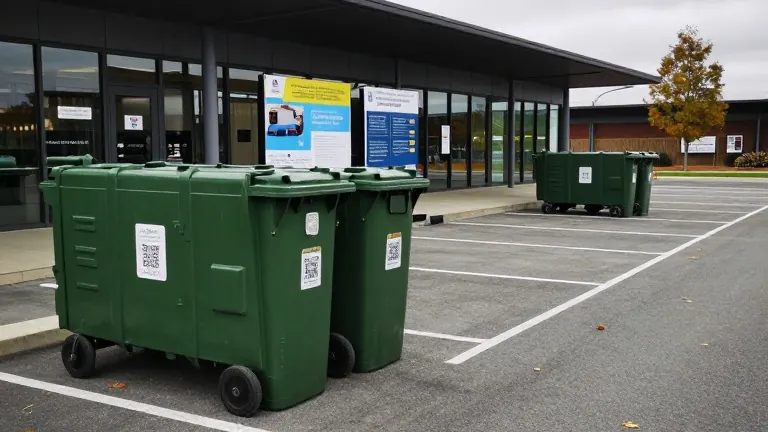
Chicago’s Department of Streets and Sanitation installed food scrap drop-off bins at eight additional public library branches last week, bringing the total number of collection points in the city to 40. The expansion adds to the 21 library locations that already participated in the free composting program, which the city launched in October 2023. Chris Sauve, the department’s Deputy Commissioner of Policy and Sustainability, stated that the new bins were placed primarily in library parking lots. Each site features banners identifying the service and QR codes that allow residents to register for the program online.
The program currently serves more than 9,500 households across the city. Sauve said the department targets 10,000 participating households by the end of the year. While registration is not mandatory for using the bins, the department recommends it to help residents receive program updates, report maintenance issues, and assist city officials in tracking usage data. Residents can also sign up at chi.gov/composting, which provides a map of all 40 active locations.
The new drop-off sites are distributed across various neighborhoods to improve geographic coverage. The Thurgood Marshall Library at 7506 S. Racine Ave. replaced a previous drop-off point at 1756 W. 74th St. Other new locations include the Humboldt Park Library at 1605 N. Troy St., the Blackstone Library at 4904 S. Lake Park Ave., and the Merlo Library at 644 W. Belmont Ave. The Sulzer Library at 4455 N. Lincoln Ave., the Near North Library at 310 W. Division St., and the South Chicago Library at 955 S. Houston Ave. also joined the network. The Legler Library at 115 S. Pulaski Road represents the final addition in this batch of eight sites.
Sauve explained that the expansion aligns with the city’s goal to offer composting services in all 77 community areas. The program began with 15 locations in 2023 and grew to 20 sites before the city partnered with Chicago Public Libraries last year to open drop-off points at 13 branches. Sauve noted that the eight new sites are spread from the north side to the south side, providing broader access for residents. The department is evaluating potential new sites in Lincoln Park and the Downtown area, where resident interest has been expressed.
The Legler Regional Library in West Garfield Park serves a dual function for the program. A food pantry opened at that location earlier this year, and any food items the pantry cannot distribute are converted into compost through the drop-off bins. Sauve said this integration helps utilize food that might otherwise be discarded. The department encourages residents to bring pumpkins to any drop-off site after Halloween to ensure these seasonal items are composted rather than sent to landfills.
Residents can drop off a wider variety of food waste at these public sites than they can typically handle in home composting systems. Acceptable items include fruit and vegetable scraps, cooked food, meat and fish bones, dairy products, bread, grains, coffee grounds, tea leaves without filters, and eggshells. Sauve emphasized that including meat and dairy is a key advantage of the public program, as these items are often excluded from backyard composting due to odor and pest concerns. The collection process involves department crews gathering the waste from bins and transporting it to a city transfer station for consolidation.
The consolidated waste is then transported to Patriot Acres, a composting facility in suburban Des Plaines. The facility requires between 45 and 90 days to process the material into usable compost. Sauve stated that the program has diverted approximately 2.4 million pounds of waste from landfills since its inception. He noted that composting reduces methane emissions, a greenhouse gas that is 80 times more potent than carbon dioxide, which is produced when food waste decomposes in anaerobic landfill conditions. Sauve said increasing participation helps improve the city’s overall waste diversion metrics.
The department plans to continue adding new locations to the network. Sauve said the goal is to ensure that composting remains accessible to as many residents as possible. The expansion to 21 library locations represents the latest step in a program that started three years ago with a smaller number of sites. The city’s strategy focuses on leveraging existing public infrastructure, such as libraries, to provide convenient drop-off points for households that may not have space for private composting. The program remains free for all participants, with no fees associated with bin use or registration.
Source: Block Club Chicago