Texas Suburbs Grow Sharply and Swing Toward Democrats
Across 16 suburban counties, registered voters rose between 30% and 83% since 2012, while the share of people of color climbed from 40% to nearly half.
By Hassan Okoye ·
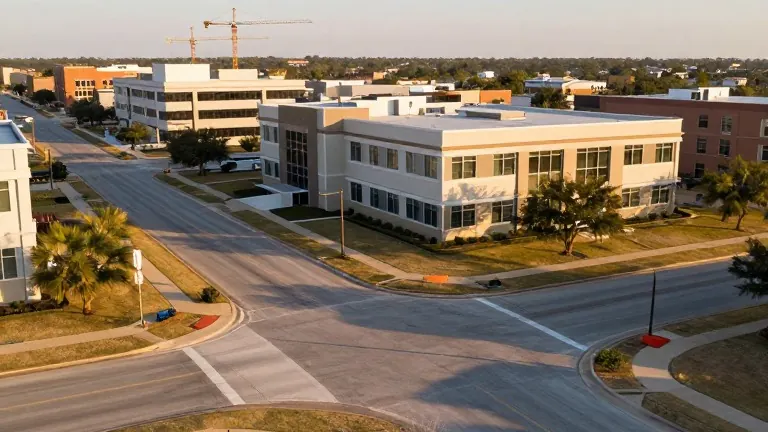
Sixteen suburban counties in Texas now account for nearly one quarter of the state's registered voters, up from about one fifth eight years ago, a shift that is reshaping next week's contests for U.S. Senate and the state legislature. Registered voter rolls in each of those counties have grown by at least 30% since 2012, with Comal County, between San Antonio and Austin, posting the largest gain at 83%. The population surge is concentrated in outer-ring communities and exurbs around Dallas-Fort Worth, Houston, San Antonio and Austin, and is driven largely by arrivals from other parts of Texas and from out of state.
The same counties are diversifying at roughly twice the rate of the rest of the state. People of color made up 40% of the population across the 16 counties in 2014 and close to half by 2024. Hays and Williamson counties, both in the Austin area, grew more than 23% between 2020 and 2025, and the white share of their populations has fallen below 50%. In Collin and Fort Bend counties, where Asian residents make up between 22% and 24% of the population, the voting behavior of Indian American and Vietnamese American communities will weigh on local races. Republicans made gains with Indian Americans and with Asian voters broadly in Texas in 2024, limiting leftward movement in those two counties.
Within the Dallas-Fort Worth metro area, the direction of travel differs sharply from one suburb to the next. Irving, an inner-ring suburb west of Dallas, moved more than 15 percentage points toward Republicans between 2020 and 2024, according to VoteHub, a larger shift than the state as a whole. Plano, north of Dallas, shifted 6 points in the same direction. Midlothian, on the southern outer ring, moved nearly 9 points toward Democrats while remaining solidly Republican. Across the 16 suburban counties, Ted Cruz's margin fell from 33 points in 2012 to 15 points in 2018; he lost the combined vote in the state's other 238 counties that year.
Fort Bend County voted for a Democratic Senate candidate in 2018 for the first time in 30 years and has repeated that result in every Senate contest since. Montgomery County, which includes Conroe and The Woodlands, has backed Republican Senate candidates in every Texas U.S. Senate race since 1988, and it supplied President Donald Trump his largest raw-vote margin of any U.S. county in 2024. Party operatives point to growth, including millions of new arrivals from outside the state, alongside frustration among some long-time suburban Republicans over the party's turn from the Bush era to Trump and MAGA. "I think you are seeing people who were part of a Republican Party that saw itself as representing upwardly mobile, younger voters," said Wayne Thorburn, who led the Republican Party of Texas from 1977 to 1983. "These are all the people that Trump has lost."
Both Senate candidates emerged from suburban state legislative seats. Ken Paxton, the Republican, first won office representing McKinney in 2002; James Talarico, the Democrat, won Round Rock in 2018. The Texas Tribune's list of suburban counties includes counties classified as large fringe metros with populations above 50,000 that contain at least one city of 25,000 or more, plus Collin County, which is designated a large central metro but sits within the Dallas-Fort Worth metro area. Populations across the 16 counties range from nearly 1.2 million in Collin to between 120,000 and 145,000 in Rockwall and Hunt counties.
The analysis excludes suburban communities inside urban counties, including areas of Harris and Dallas counties beyond Houston and Dallas. Past election results in the district-level maps were projected onto Texas House boundaries enacted in 2023, with data from the Texas Legislative Council.
Source: KPRC-TV