Syria Moves to Join Mecca Alliance as Turkey Bolts Regional Ties
A new Sunni-led security pact aims to fill a potential power vacuum left by an unstable Iran, prompting concerns in Jerusalem about regional balance.
By Isabella Kaur ·
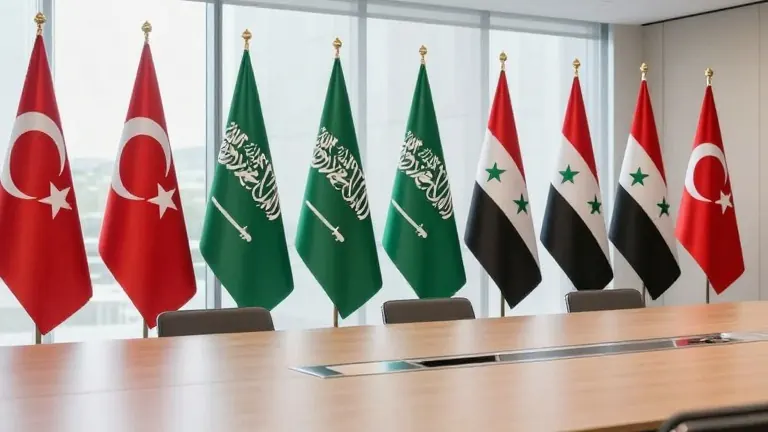
Syria is formally evaluating its entry into the Mecca Pact, a security alliance that could reshape power dynamics in the Middle East if Iran’s Islamic regime collapses. Yoni Ben-Menachem, a senior researcher at the Jerusalem Center for Public Affairs, argued on Sunday that this move serves Turkish interests by strengthening a Sunni Islamist axis led by the Muslim Brotherhood. He suggested the pact is designed to occupy the space left by the Shi’ite axis if Tehran falls.
Syrian Foreign Minister Asaad al-Shaibani confirmed on Saturday that discussions are underway to assess Syria’s participation. The alliance currently includes Turkey, Saudi Arabia, and Pakistan, with Egypt also expected to join soon. Ben-Menachem predicted that Qatar would soon announce its intention to consider membership. He noted that the pact includes Sunni nations outside the Muslim Brotherhood, creating a broad coalition against the current Iranian order.
Despite the potential for confrontation, Iran has responded positively to the alliance so far. Experts told The Jerusalem Post that Tehran views the pact as a strategic shift away from Washington. This move weakens the United States’ influence in the Middle East and the Gulf. Senior officials from the pact countries held open talks with Tehran in Iran last week, signaling a diplomatic engagement alongside the military alignment.
Ben-Menachem contended that Syria’s expansionist ambitions extend beyond its borders. He stated that Damascus seeks to claim the Golan Heights, territory Israel captured during the 1967 Six Day War. He argued that this desire for expansion is not merely a reaction to Israel’s security zone but a long-standing aspiration. Syria previously maintained a military presence in Lebanon until 2005, withdrawing only after the assassination of former Prime Minister Rafic Hariri.
Domestically, Syria is rebuilding its army using more than 130 armed groups dispersed across the country. Hay’at Tahrir al-Sham forms the backbone of this new military structure, backed by Turkish support. Israeli security sources warn that this new army poses a danger to Israel if it successfully unifies. Its members are described as jihadists who are considering future attacks against Israel, supported by a Turkish government that remains hostile to Jerusalem.
Israel maintains that the threat justifies the establishment of its security zone in Syria. Ben-Menachem stated that Israel cannot risk withdrawing from the zone because the new Syrian military could replicate the attack Hamas launched against Jewish communities along the Gaza border. The alliance brings together major Sunni powers in a coordinated effort to secure regional influence ahead of potential political shifts in Tehran.
Source: The Jerusalem Post