Security forces beat dozens at Tehran Halloween gathering
Iranian authorities detained and assaulted participants in a central Tehran celebration that defied new local bans on the holiday.
By Hassan Okoye ·
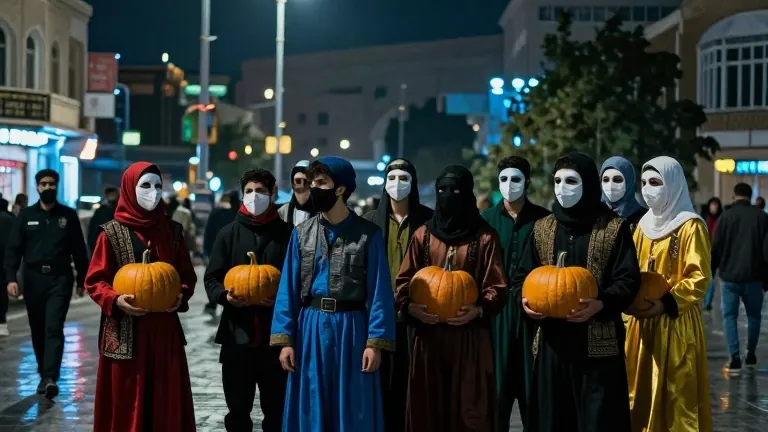
Iranian security forces intervened to disperse a Halloween gathering in central Tehran on Friday, detaining and beating several attendees. The incident occurred despite the fact that the Islamic Republic has no specific law prohibiting the holiday or the sale of related goods. Officials and plainclothes officers moved to break up the event in a city square, marking a sharp enforcement action against a cultural celebration that has become a point of friction between the state and the public.
The crackdown followed a week of public defiance. Residents in various cities dressed in costumes and attended parties despite warnings from local authorities. Iranian media reported that plainclothes officers and members of the Basij militia gathered near Tehran’s Artists Park to disperse young people wearing makeup and costumes. A witness told Iran International that the scene resembled previous protests, with officers shouting for families to flee. The group was running after people and shouting, “Disperse!”
Online footage from the event showed women leaving their hair uncovered and exposing their legs. This behavior directly challenged the strict dress code enforced by the state. The timing of these celebrations coincides with a renewed national effort to redeploy morality police and enforce mandatory hijab laws. The visual display of non-compliance served as a public rejection of these regulations, drawing attention to the gap between written rules and daily practice.
Local authorities had moved to restrict the holiday before the Friday incident. The Iranian legal advocacy network Dadbaan warned earlier this week that new restrictions were being imposed in several cities. In response, cultural venues canceled planned events. Isfahan’s Isal Café and the Madam and Monsieur Mansion issued cancellation notices. Staff at the Madam and Monsieur Mansion cited compliance with the law and “Islamic proprieties” as their reason. The Cultural Heritage Department in Aran va Bidgol also prohibited celebrations, aiming to preserve “Islamic and Iranian values.”
Dadbaan emphasized that no existing law in Iran bans the sale of Halloween items, the holding of parties, or the use of themed decorations in commercial spaces. This legal vacuum has allowed the state to impose ad hoc restrictions through administrative orders rather than parliamentary statutes. The network argued that the recent crackdowns rely on informal enforcement rather than codified rules.
The Islamic Republic has a history of targeting alternative subcultures. Gothic and alternative groups have frequently been labeled “satanic.” Prior to the recent conflicts with Israel and the January protests, shops selling clothing with unconventional symbols faced threats of closure. The January crackdown resulted in the reported deaths of tens of thousands of people. This history of repression shapes the current dynamic where cultural expression is viewed with suspicion by the regime.
Nazanin Nour, an Iranian-American actress and writer, addressed the event online. She pushed back against Western claims that the festivities indicate a loosening of control. She wrote that the “people of Iran push boundaries at their own risk (which very much still exists because repression is codified into law); it’s not that the boundaries are being eased by the regime.”
Beni Sabti, an Iran expert at INSS, described the growing size of the Halloween events as a form of cultural protest. He noted that this year’s costumes were more daring, featuring masks and gothic styles rather than the animal themes seen in previous years. “Listening to music, playing music in the streets, going without hijab, all these clips that you see, it’s kind of a protest,” he said. “They don’t even know if they want to be in a huge protest. So everyone protests individually.”
Source: The Jerusalem Post