Pyongyang Accelerates Drone Output With Moscow Support
North Korea is scaling up its unmanned aerial fleet and refining missile accuracy through a deepening military exchange with Russia.
By Hassan Okoye ·
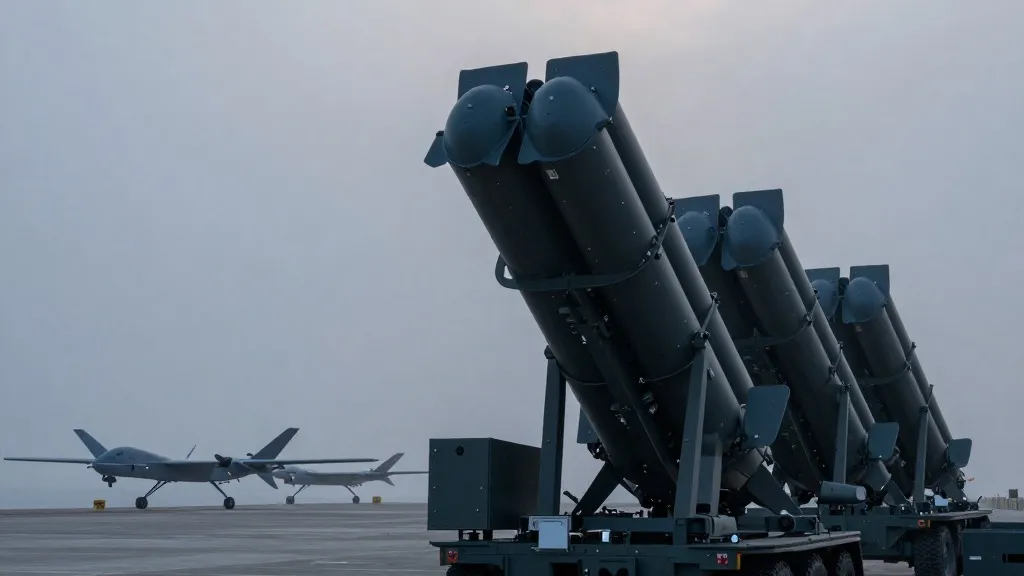
A significant shift in the balance of military power is emerging on the Korean Peninsula, driven by a strategic partnership that has accelerated North Korea's offensive capabilities. The nation is currently mass-producing attack drones and refining its ballistic missile technology, a development largely attributed to technical transfers from Russia. This surge in production and sophistication marks a distinct departure from previous years, as Pyongyang leverages Moscow's military expertise to modernize its arsenal in exchange for personnel, labor, and weaponry.
The deepening of these military ties began following Russia's full-scale invasion of Ukraine. Since that conflict started, the two states have engaged in a reciprocal arrangement where Moscow shares its latest defense developments with Pyongyang. In return, North Korea provides Russian forces with soldiers, industrial workers, and various munitions. This collaboration has allowed the North Korean military to modernize its equipment at a pace that observers had not previously anticipated.
Recent testing activities have underscored this progress. In early October, Pyongyang conducted a trial of a tactical ballistic missile, asserting that the weapon is capable of carrying a nuclear warhead. South Korean and Japanese analysts estimated the missile traveled approximately 700 kilometers, whereas North Korean officials claimed a range of 1,000 kilometers. The discrepancy in these figures highlights the ongoing debate over the true capabilities of the new system.
The response from the South has been notably different from past incidents. Seoul typically issues brief, declarative statements describing such launches as provocative acts. However, following the recent North Korean test, South Korea conducted its first-ever launch of a hypersonic ballistic missile just five days later. President Lee Jae Myung personally witnessed the trial. This direct retaliatory signaling suggests that Seoul is growing increasingly concerned about the rapid advancement of its neighbor's missile technology.
Analysts point to specific Russian inputs as the key to these improvements. Anton Ponomarenko, a defense analyst, noted that access to Russian deployment data and feedback mechanisms has significantly enhanced the precision and maneuverability of North Korean weapons. This technological exchange has rendered the threat posed to South Korea more substantial than in the past, complicating defensive strategies for the region.
Beyond missiles, Russia has assisted Pyongyang in establishing a robust unmanned systems industry. The New York Times reported that North Korea has observed the effectiveness of inexpensive drones in Ukraine and the Middle East, where they have proven capable of overwhelming expensive air defense networks. Motivated by these examples, the North has begun producing these aerial assets in large volumes. In a military drill last month, a swarm of drones was deployed to strike a target island simultaneously with cruise and ballistic missiles approaching from multiple directions.
This evolving tactical approach is expected to place significant financial pressure on South Korea and its international allies. The cost of developing new air defense systems to counter such combined attacks is projected to be exorbitant. The strategic implication is that the North is forcing its adversaries to invest heavily in defensive infrastructure to maintain security.
These developments follow other reports detailing the breadth of the Russo-North Korean partnership. Bloomberg reported in September that Russia is utilizing North Korean citizens to manufacture military drones, particularly at facilities in Alabuga, Tatarstan. Estimates suggest that up to 25,000 North Korean workers are currently employed at Russian military plants. Additionally, a North Korean missile unit, potentially equipped with 120 ballistic missiles and six launchers, has begun deploying in western Russia for strikes against Ukraine.
The recent reporting aligns with a series of prior announcements from Pyongyang. In June 2026, North Korea revealed tests of a modernized 240mm multiple-launch rocket system, a tactical ballistic missile, and a 155mm long-range artillery shell. Furthermore, Ukraine reported in August that Russia had requested the supply of KN-30 ballistic missiles from North Korea. These cumulative events paint a picture of a rapidly expanding and technologically sophisticated alliance.
As the partnership continues to mature, the international community faces the challenge of monitoring and responding to these changes. The integration of Russian technology into North Korean systems, combined with the mass production of drones, represents a new phase in regional security dynamics. The coming months will likely see further testing and deployment as both nations refine their collaborative military strategies.
Source: Ukrainska Pravda