Jordanian church funeral hit by gunfire
A shooting at a Greek Orthodox service in Karak has killed seven people and injured forty, prompting a national response and regional diplomatic outreach.
By Isabella Kaur ·
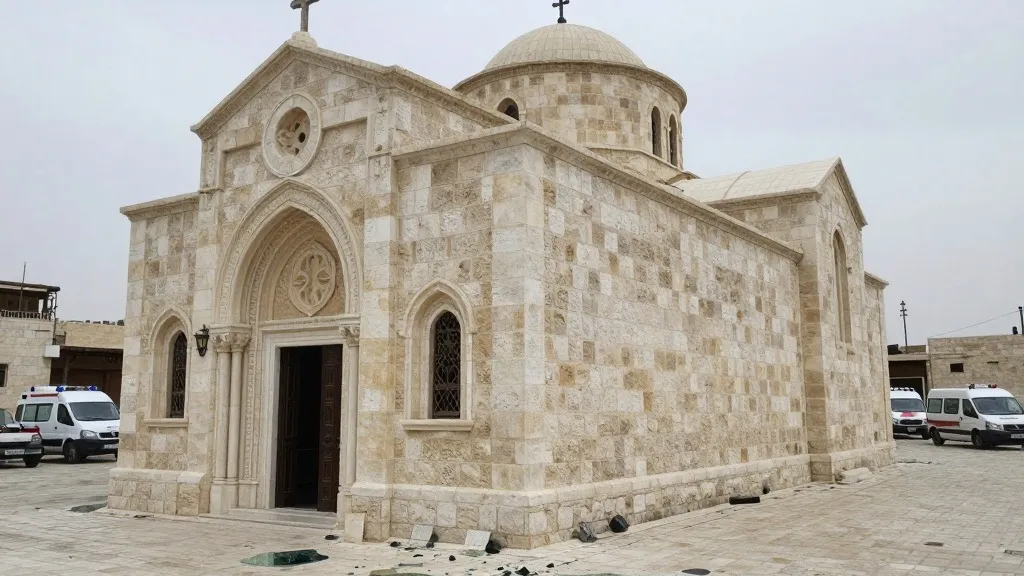
The stability of the Middle East's key transit and energy hub faced a new test this week when violent conflict erupted within a place of worship. On Friday, gunmen targeted a funeral service at a church in Jordan, resulting in a significant loss of life and prompting immediate governmental and international reactions.
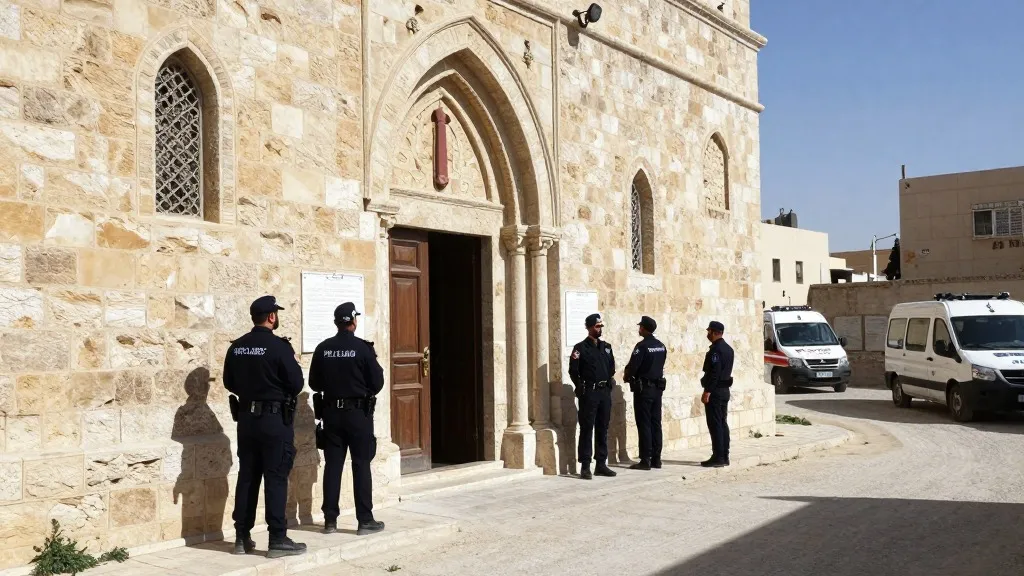
The incident occurred at a Greek Orthodox church in Karak, a town located approximately 90 kilometers south of the capital, Amman. According to state authorities, the attack left seven individuals dead and forty others wounded. State television broadcast footage showing the initial moments of the assault. Two men, appearing to carry pistols, moved toward the building and opened fire. A third individual, who seemed to be holding a semiautomatic rifle, then advanced and added to the barrage. The attackers subsequently ran toward the church structure. Witness recordings captured the aftermath inside, revealing shattered glass and blood on the floor.
Dorgham Halasa, a mourner present during the service, described the sudden onset of violence. He stated that intense gunfire began about 15 minutes into the funeral, causing attendees to flee. Halasa noted the chaotic nature of the event, describing it as a weird situation accompanied by heavy gunfire. While he did not see the assailants directly, he reported that others in the congregation had spotted four individuals. The exact number of attackers remains unconfirmed by independent sources, and Jordan's security services have not yet released specific details on the group's size.
The timeline of this escalation builds on a history of regional insecurity. Jordan has previously dealt with significant security challenges, most notably in 2016 when gunmen ambushed police in Karak. That series of attacks, which included an assault at a Crusader castle popular with tourists, resulted in ten deaths, seven of whom were officers. The current incident marks another significant episode of violence in a town that is home to a minority Christian population.
In the immediate aftermath, the government issued a statement characterizing the event as an action carried out by unknown assailants. Officials did not specify whether any of the gunmen had been captured or killed, but they emphasized that investigations were proceeding at full speed. Health Minister Ibrahim al-Budour provided a medical update, indicating that two of the wounded are in critical condition. The kingdom has declared three days of national mourning to honor the victims.
Political leadership has moved quickly to frame the response. King Abdullah II posted on X that Jordan will confront the terrorist act with the harshest penalties. He extended his deepest condolences to the families of the deceased and wished for the recovery of the injured. Prime Minister Jafar Hassan, speaking at a security meeting in Karak on Friday evening, attributed the attack to terrorist ideology and blind extremism. He assured the public that legal measures would be taken against those seeking to introduce extremism and that the attackers would be punished.
The diplomatic ripple effects have already spread across the region. Condemnation has arrived from Lebanon, Syria, Egypt, and Oman. In Cairo, Ahmed al-Tayeb, the grand imam of Al-Azhar, described the shooting as a heinous terrorist attack and offered condolences to the victims' families. Iraqi Foreign Minister Fuad Hussein contacted his Jordanian counterpart to affirm Iraq's solidarity with Jordan in the face of terrorism, according to his office.
International bodies have also weighed in on the incident. United Nations Secretary-General Antonio Guterres condemned the attack, noting that it was especially heinous because it took place during a funeral. His spokesman, Stephane Dujarric, stated that the secretary-general is calling for all those responsible to be found and held to account. As the investigation continues, the focus remains on identifying the perpetrators and assessing the broader implications for security in the region.
The next phase will likely involve a detailed forensic review and a search for the unidentified assailants. Markets and regional observers will be watching for any changes in security protocols or further diplomatic statements. The outcome of the investigation will be crucial in determining whether this is an isolated incident or part of a larger pattern of instability in the area.
Source: NPR