European protests see fewer arrests as France and Germany report localized clashes
Police in Paris and Frankfurt dealt with smaller waves of violence compared to mid-October, while new demonstrations are planned for Tuesday and Thursday.
By Hassan Okoye ·
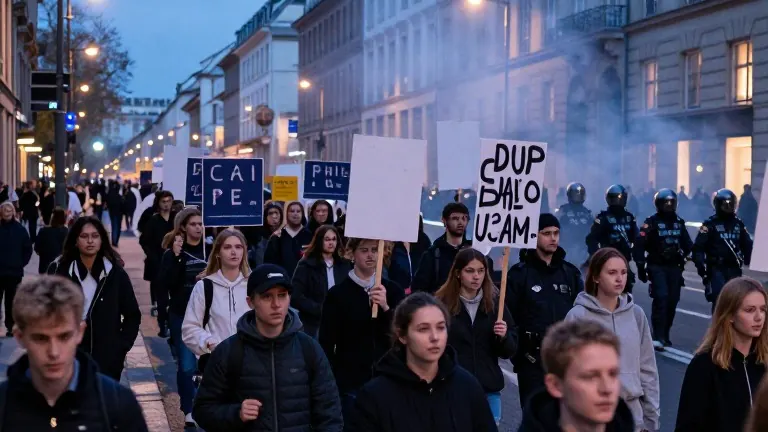
Cost-of-living protests have swept across Europe over the last month, but the intensity of the clashes has shifted this weekend.
French authorities reported a decrease in violence during the Saturday marches, marking a break from the heavy damage seen in previous weeks. Police in Paris noted that while some incidents occurred, the overall level of disruption was lower than in mid-October.
In Paris, rioters threw Molotov cocktails at officers at the end of the march in the eastern part of the city. Three police officers were injured and one car was set on fire. On the western side of the city, masked groups launched fireworks at agents near the Eiffel Tower. Police charged repeatedly, causing frightened tourists to flee the area.
The number of arrests reflected the calmer tone. Police detained 779 people by Saturday night. This figure is far lower than the 2,628 arrests made on October 17 and the 1,314 arrests from the previous weekend. On October 17, a town hall building was burned and more than 2,000 shops were looted in a few hours. Police and Marseille officials reported attacks on a few businesses this weekend, but the damage was not extensive.
A national police official told The Associated Press that authorities prepared for a larger crowd of both peaceful marchers and rioters. Around 70,000 police officers were deployed across the country. The official spoke on condition of anonymity because police policy did not allow public identification. New protests are expected once schools reopen on Monday. Student groups and unions have called for national demonstrations on Tuesday and Thursday.
Germany faced its own challenges on Saturday as more than 100,000 people, mostly young adults, marched peacefully. They demanded more government spending on education, housing, and environmental protection. While the day was largely calm, violence broke out in some cities at night.
In Frankfurt, rioters attacked police in the city center and looted shops. More than 100 officers were injured, and 54 people, aged between 13 and 29, were arrested. Police said 17 stores were damaged and five were looted. The situation settled down in the early hours of Sunday after police cordoned off part of the center. Boris Rhein, the head of Hesse, said he was shocked by the violent excesses in Frankfurt. He stated that those who act like the attackers place themselves outside society.
Violence also erupted in Cologne, where police used water cannons to disperse the crowd. In Berlin, protesters attacked officers with bottles and firecrackers. The organizers of the Saturday protests, a youth initiative called Generation Z Will Take Over, posted a statement on Instagram. They distanced themselves from any form of violence and from violent acts by other groups or individuals who were not part of the organized march.
German Interior Minister Alexander Dobrindt accused violent left-wing groups and rioters from the immigrant community of hijacking the peaceful marches. He told the newspaper Bild on Sunday that the rioters and looters would be identified and held accountable.
In Portugal, the focus remained on housing costs. Riot police forcibly removed protesters from a square in Lisbon during the night. Thousands marched through the city during the day, and hundreds camped in Rossio, a central square. Police intervened in the early hours of Sunday, removing tents and pushing people out to clear the area. Some protesters were detained. These demonstrations have continued for weeks, inspired by a similar movement in Spain, to protest rising costs of daily life, especially housing.
Source: Pioneer Press