Azov says clashes near Kyiv were carefully planned and may have involved Russia
The 1st Azov Corps has given its account of the 2 November clashes outside Kyiv that injured 16 National Guard servicemen, describing a carefully planned confrontation it says may have involved Moscow.
By Hassan Okoye ·
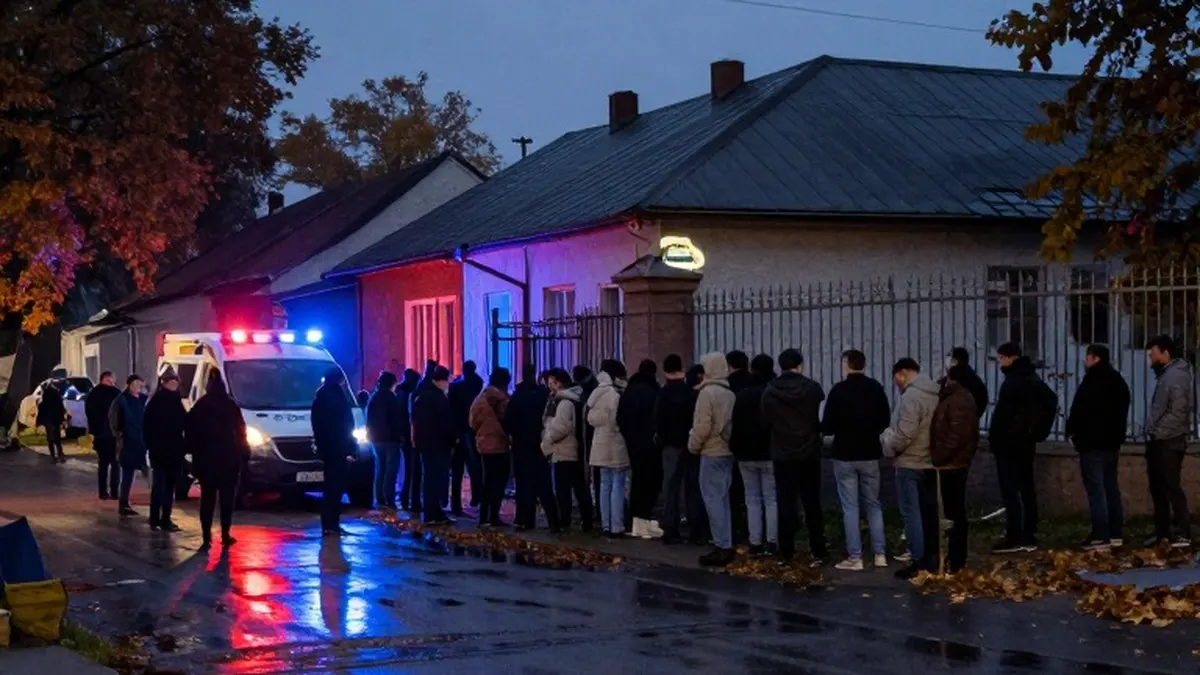
Clashes erupted on 2 November in Petropavlivska Borshchahivka, a village on the outskirts of Kyiv, after a crowd demanded the release of servicemen from a building that turned out to be a temporary deployment point of the 1st Azov Corps of Ukraine's National Guard. Sixteen National Guard servicemen were hurt in the confrontation.
The incident began when an ambulance arrived and blocked the gates, and a woman dressed as a doctor, Valentyna Moloda, started livestreaming claims that people were being tortured in the basement, urging viewers to come. Local residents and up to 20 teenagers gathered, and the mob tried to storm the building, spraying tear gas and pepper spray at National Guard personnel and throwing stones.
National Guard Commander Oleksandr Pivnenko and Kyrylo Budanov, Head of the President's Office, arrived, and the mobilised soldiers were brought out to be bused to another deployment point, since the location had been exposed to the Russians. But Pavlo Kurchenko, commander of Military Unit 3121, which oversees the site, said people in the crowd pulled the men in different directions and attacked the bus, smashing windows. The soldiers dispersed, but all later returned voluntarily, most of them during the night.
Kurchenko said 26 mobilised servicemen had been staying in the building, only two of them returned to service after going absent without leave. Valentyn Dziubenko of the corps' Strategic Communications Department said housing small groups in ordinary rented houses is standard practice across Ukraine's defence forces for security reasons. Kurchenko insisted relations with neighbours were good: personnel wore civilian clothes and went out only after dark. Some locals, however, said complaints about the street had circulated in local group chats for about two weeks.
Moloda had claimed that "a lot of people had been beaten" and one had even "died", but once allowed inside, all were alive. Four mobilised servicemen were injured and taken to a National Guard medical facility. One of them, Andrii Kuleshov, was being held "in quarantine to readjust after going AWOL" after deserting from the 52nd "Forge" International Assault Regiment; his details appear on the Myrotvorets website over repeated illegal crossings between Ukraine and the Russian-backed "LPR/DPR" from 2015 to 2021.
Ivan Yareshko, mobilised on 30 October, behaved erratically on arrival; a rapid drug test found narcotics in his urine, and after trying to attack the medic he was isolated in a separate room, where he began self-harming behaviour. Oleksandr Pavliuchenko hurt his back going to a shelter during an air raid and was diagnosed with a healed fracture of the ninth thoracic vertebra; after severe alcohol intoxication and repeated rule violations he was discharged against his will and placed under the unit medic's supervision. Oleksandr Perminov was not considered injured: he had encouraged others to desert and then gone AWOL himself. The corps says all four are now well and internal investigations have begun.
The injured men left in Moloda's "ambulance" on condition they go to a National Guard medical facility with the deputy commander responsible for personnel affairs, as the corps' own medics were trapped inside. Kurchenko said the unrest began because of Kuleshov, whose relatives had been trying to get him out of service. His mother tried to "make a deal" and offered a serviceman a bribe, which was refused; "a figure of around US$7,000 was mentioned", the commander said.
Kurchenko said the incident was very carefully planned and suggested Russia may have been involved. Dziubenko said monitoring after the first livestreams showed a coordinated wave of content on anonymous Telegram channels, while bots on Threads and Facebook spread Russian narratives about "abuses by enlistment offices". "The only beneficiary of this situation is our enemy," he said, naming the Russian Federation. The corps stressed it considers any physical or psychological pressure on personnel unacceptable. It said there is no evidence the campaign targeted Azov, a focal point of Russian propaganda since 2014, but did not rule it out, and noted Moloda had long called for Ukraine's capitulation and an end to mobilisation.