Three Halley Comet Meteors Recorded Over Georgia Town Before Orionid Peak
A composite image captured in Toccoa shows bright trails from the Orionid shower, which remain active until early November.
By Isabella Kaur ·
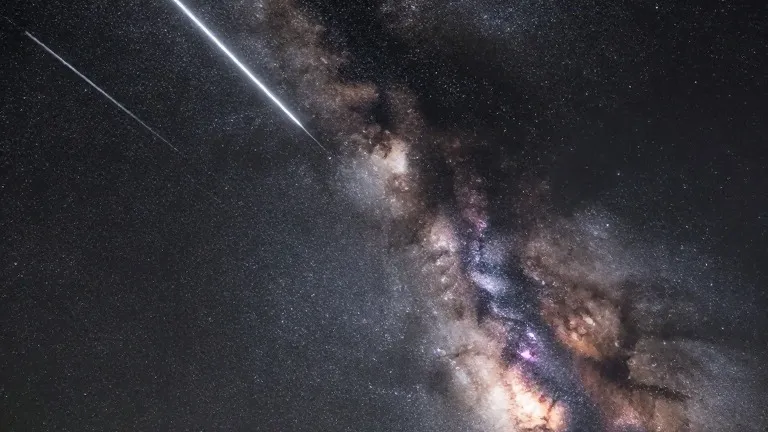
Three bright meteors from the Orionid shower flashed across the sky above Toccoa, Georgia, in the early hours of Oct. 21. Astrophotographer Tim McCollum recorded the events between 3 a.m. and 4 a.m. local time. The streaks were produced by debris from Comet 1P/Halley, which is currently more than 3 billion miles from Earth.
McCollum created the image by merging multiple 30-second exposures. He used a Canon EOS Ra camera paired with an RF 28-70 f2.0 lens. A star tracker kept the equipment pointed at the shower's radiant, a point in the sky near the red giant star Betelgeuse in the constellation Orion. The final composite was processed using PixInsight software.
The resulting photograph features more than just the meteor trails. The stars of Orion's Belt appear on the right side of the frame, close to the Orion Nebula. This is one of the nearest major star-forming regions to Earth. The Rosette Nebula, cataloged as Caldwell 49, is also visible within the dense starfield and dust lanes of the Milky Way's galactic plane. Numerous star clusters are visible throughout the image.
The Orionid meteor shower is entering its peak activity period. The annual display is expected to continue until Nov. 7. Observers can still attempt to spot meteors from Halley's Comet on the coming nights. The shower's radiant lies in the direction of Orion, making the constellation a key area for skywatchers to monitor.
Earth is currently passing through debris streams left by Comet 2P/Encke. This activity produces the Taurid meteor shower. The Taurids can occasionally generate large, bright events known as Halloween Fireballs. These fireballs may provide a visible bonus for people watching the skies during this period.
Space.com is inviting readers to submit their own astrophotography. Interested individuals should send their photos, comments, name, and location to spacephotos@space.com. The publication uses these submissions to feature community observations and capture the visual record of the current astronomical season.
Source: Space.com