Thames Estuary Wreck Masts Cut and Moved to Chatham Museum
Crews finished a $13 million job to remove deteriorating structures from the SS Richard Montgomery, leaving 1,500 tons of WWII explosives on the seabed.
By Hassan Okoye ·
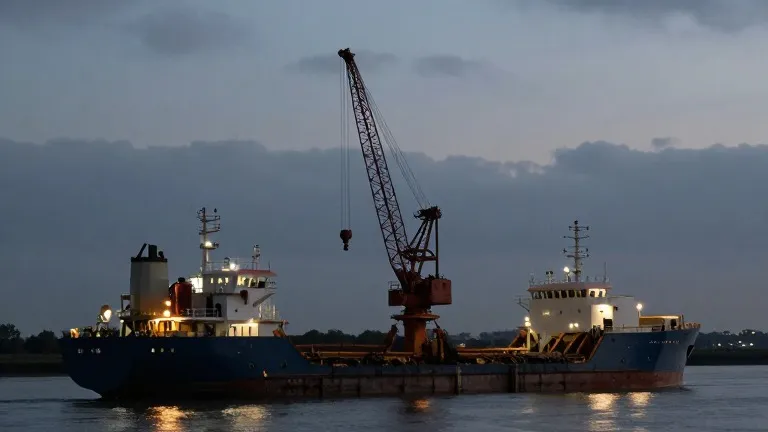
Crews have completed the removal of the three masts from the SS Richard Montgomery, a World War II shipwreck resting in the Thames Estuary.
The operation, which cost just under $13 million, finished ahead of schedule according to U.K. maritime minister Keir Mather. He told the House of Commons that the masts had placed a heavy load on the sinking structure. Removing them reduces the risk of structural failure and supports the long term management of the site.
The Montgomery ran aground in August 1944 near Sheerness, roughly 40 miles from London. It was one of 2,700 ships built in the United States to support Allied forces. The vessel broke apart during early salvage attempts and sank with an estimated 1,500 tons of explosives in its holds. These munitions were intended to support operations following the D-Day landings.
For decades, the masts remained visible above the waterline. Recent surveys showed the rusting structures were deteriorating. Officials feared the masts could collapse onto the cargo below. Nolan Conway, a naval architect with Florida based Resolve Marine Group, explained that the ship had begun to lean. He warned that the masts could have fallen onto the cargo and caused a detonation. Some of the munitions are believed to have pressure fuses, meaning an impact could trigger an explosion.
The engineering team faced the challenge of cutting the masts without shaking the wreck. They built a custom lifting frame to raise each mast clear without swinging. To avoid using divers, the team employed a remotely operated underwater diamond wire saw. This device clamped around each mast with hydraulic arms and cut through the metal from the water.
The explosives remain in place because removing them carries considerable risks. Experts disagree on the potential impact of a detonation. Conway said estimates range from shoreline damage to a tidal wave traveling up the Thames, or a minor event that might only close a nearby shipping channel. He noted that while the range of impacts is wide, none are ideal. Officials still judge the overall chance of an explosion to be low.
The masts have been moved to the Historic Dockyard Chatham museum. Mather said they will be displayed to recognize the ship's role in supporting Allied forces. The government has maintained an exclusion zone around the wreck, which lies about 1.5 miles off the Sheerness coast. Mather confirmed the site will continue to be subject to continuous monitoring and control through that zone.
Source: CBS News