Lunar towns may cap at 10,000 due to water
A new study estimates that available moon water could sustain a small settlement for centuries, but a city of a million people for only a century.
By Isabella Kaur ·
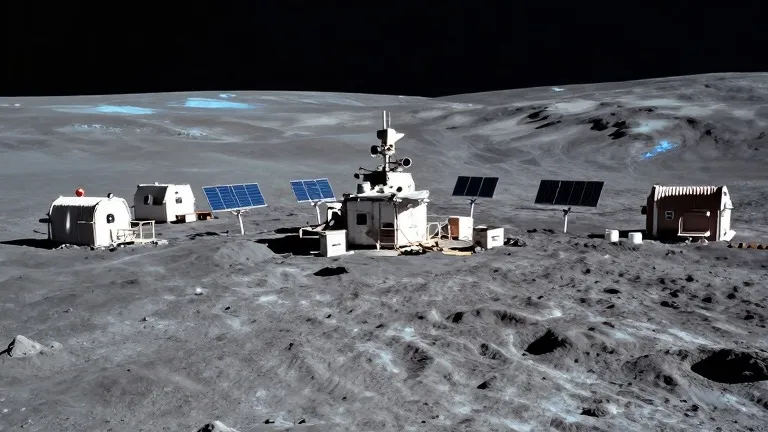
Future lunar residents may face strict population limits based on available water reserves. A new study indicates that while the moon has water, the quantity is too low to support the massive urban centers envisioned by some tech leaders. For ordinary people interested in space travel, this suggests early colonies will resemble small towns rather than sprawling metropolises.
The analysis was published in the journal Frontiers in Space Technologies. It was conducted by Martin Elvis of Harvard University and Jonathan McDowell of Durham University. The researchers examined two key resources: power and water. They determined that solar and nuclear energy could easily support one million people. Water, however, presents a much tighter constraint.
The study assumes the moon holds approximately one billion tonnes of water. Most of this is believed to be located in permanently shadowed areas at the poles. Under these conditions, a population of one million could survive for about 100 years. This estimate requires recycling 98 percent of all water used, a standard achieved on the International Space Station. A group of 10,000 people could remain sustainable for centuries using the same resources.
Martin Elvis described the estimated water supply as modest. He compared it to an aquarium the size of Central Park filled until the Statue of Liberty was just submerged. He noted that such a volume is essentially a small lake, insufficient for a large city. Elvis believes the initial estimate of one billion tonnes is likely 20 or 30 times too high. He suggests only one percent of the original figure is realistically recoverable, which would reduce the 100-year lifespan for a million people to just one year.
The physical state of the water adds complexity. Gordon Osinski, a professor at Western University, said satellite data contains uncertainties. He suspects the water may exist as sub-millimetre ice crystals mixed into soil, similar to Arctic permafrost. This form would be difficult to extract. Osinski wants ground-based confirmation to verify the presence and state of these reserves.
These findings follow bold claims by industry leaders. Elon Musk stated in February that SpaceX aims to build a self-growing city on the moon in under 10 years. Jeff Bezos has predicted that millions of people will live in space by 2045. McDowell argued that the new data does not discourage exploration. He stated that the truth is never negative, and that attempting projects that will not work is the real problem.
Source: CBC News