London Mayor Hails Oxford Street Closure as Traffic-Free Zone Opens
A 1.9km stretch of the capital's busiest shopping road is now vehicle-free, prompting mixed reactions from shoppers, drivers, and cyclists.
By Hassan Okoye ·
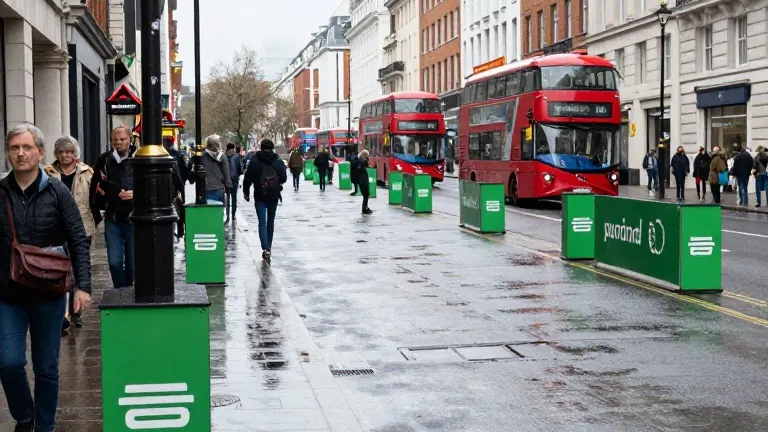
On a wet Monday morning in London, Sadiq Khan declared the pedestrianization of Oxford Street a "momentous day." The closure to vehicles, which spans roughly half of the 1.9km street from Oxford Circus to Marble Arch, took effect in time for the Christmas shopping season. Buses, taxis, e-scooters, and private cars have been banished from the central corridor, replaced by a green banner and temporary bollards that guide pedestrians onto the tarmac.
Shoppers on the street expressed relief at the extra space. Daniel Te, who moved to London from the United States in July, sketched the scene, noting that the street feels like an "entirely new place." Te, a former city planner, said the change made him more inclined to visit, as he previously avoided the area because it was too busy. He described the pedestrianization as a major achievement, though he acknowledged that rerouting buses might inconvenience some commuters.
Raquel Cox, visiting from Ireland, traveled to the street after seeing news coverage of the project. She described the environment as "a better experience" for shoppers, despite potential traffic increases on surrounding roads. Abbas Shigival, who runs a souvenir kiosk at the start of the closed section, observed that the morning was slightly busier than usual and that customers seemed happier in the car-free zone. Khan, who began his career in retail on Oxford Street, echoed these sentiments in a speech at John Lewis, stating that investing in people rather than traffic should lead to better footfall and spend.
Not all residents and workers welcomed the change. Ben McMullan, a taxi driver, reported that traffic on neighboring streets had worsened and that accessibility for customers without direct car access had become a problem. He recounted dropping off a passenger with walking difficulties who was disappointed by the lack of direct vehicle access. McMullan feared the changes could hurt his business, as he believes customers may avoid taxis if they cannot reach their destinations easily.
Cyclists also faced adjustments. Jack, a construction worker who rides his bike to work, was stopped by security guards multiple times. He expressed frustration, stating that he would continue riding the street regardless of the new rules because alternative routes made his commute longer. He argued that the move mirrored low traffic neighborhoods, which he felt made it harder for people to use vehicles.
The current closure is a temporary measure ahead of a permanent £150m transformation starting in spring 2027. That larger project will include trees, seating, and level plazas for events. Claire Mann, chief operating officer at Transport for London, said the changes should not affect bus reliability, noting that the Elizabeth Line and Bond Street station provide alternative access points. Khan said the city would closely monitor the changes to ensure they work for everyone, calling the current phase a "proof of concept."