Palestinian Israelis Brace for New Settlements Ahead of Elections
Villagers in Majd al-Krum fear recent settler incursions are a trial run for a larger demographic shift in the Galilee region.
By Hassan Okoye ·
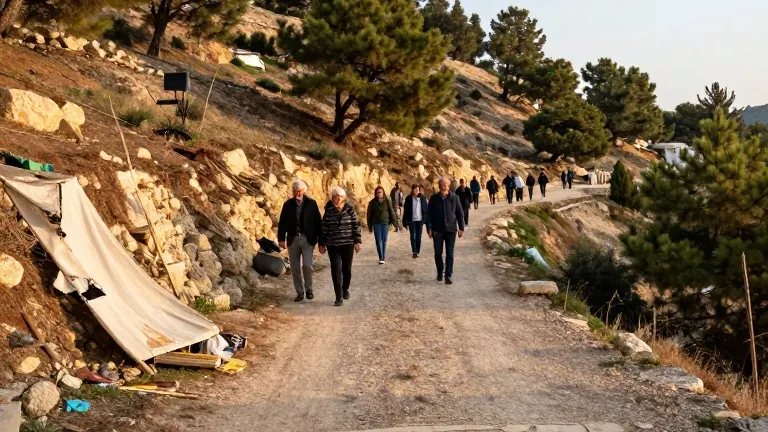
Villagers in Majd al-Krum, Israel, are preparing for a potential expansion of Jewish settlements into the Galilee region, a fear intensified by recent incursions and political campaigning. The concern centers on Finance Minister Bezalel Smotrich, who has promised to increase the Jewish population in the area ahead of the general election scheduled for Tuesday.
In mid-September, settlers from the occupied West Bank established a temporary outpost on a hilltop known as al-Rus. The group claimed they held a grazing permit from the Jewish National Fund, but local residents noted the absence of livestock. Within a week, the camp expanded to include 25 to 30 people, along with infrastructure such as a kitchen, toilet, water line, and electricity, according to village estimates.
The land in question is roughly two acres, or 8.4 dunams. Husein Khalaily, a local economic consultant, stated that the plot is split between private ownership and administration by the Israel Land Authority. The authority has long refused to partition the land to clarify private ownership boundaries, a procedural hurdle the settlers bypassed.
Local residents responded to the incursion by climbing the steep, pine-covered hill on foot, by horse, and in off-road vehicles. They continued these daily treks after police closed the main road to the site. Protests lasted for nearly a week, drawing participants from neighboring towns including Sakhnin, Arrabeh, and Deir al-Asad.
Hanan, a Palestinian Christian from a nearby village, described the period as a time of unusual unity among the Arab community. She noted that the situation made the distant reality of West Bank outposts feel immediate. "I never saw the Arab community so united and really fighting for their lands," she said.
Police removed the settler tents by September 16 following an order from the Jewish National Fund. However, the organization later announced it would move the grazing initiative to a different plot 500 meters away. Village leaders rejected this relocation, insisting they would not accept even one tent on land they consider theirs.
Smotrich campaigned in Majd al-Krum with a police escort and a water cannon. He used a September 18 police arrest of a local resident to suggest the area was in the "atmosphere of October 6," referencing the 2023 attack. The Finance Minister previously posted a plan to add one million Jews and 40 new communities to the Galilee and the Negev, where large Palestinian populations reside.
Anas Sgaier, a 21-year-old law student who helped organize the protests, said the settlers' actions proved the political rhetoric was moving into practice. "He came here and said it clearly: 'I want to Judaise the Galilee,'" said Khalaily. He added that previous language about development has been replaced with more direct terminology regarding demographic change.
Election polls indicate that neither of the main political blocs can reach a majority of 61 seats without support from Arab parties. Turnout among Palestinian citizens of Israel has typically ranged between 45 and 65 percent in recent years. Organizers now expect participation to reach 70 to 75 percent, a level last seen in 1999.
Husein Mannaa, a lawyer and member of the village committee, predicted turnout in Majd al-Krum could exceed 80 percent. He believes the recent provocations have motivated previously indifferent voters to participate. "They know well what awaits us if this government returns to power," Mannaa said.
The settlers have left the al-Rus site, though Hebrew graffiti remains on the ground. Villagers now use the hilltop for daily activities, including barbecues and music. Local musicians composed a song titled "Ibn Bladi" during the protest period, emphasizing their connection to the land. The song references the broader homeland rather than just the specific village, reflecting a regional sense of identity.
Khaled Kewan, a singer from the village, said the settlers' efforts are not limited to Majd al-Krum. He described the movement as a wider campaign affecting the entire Galilee. The village maintains its daily presence on the hilltop as a symbolic assertion of continuity, despite the temporary removal of the settler camp.
Source: Al Jazeera