King Charles III Arrives in Bahamas as Reparations Calls Intensify
The monarch's first official visit to the archipelago coincides with protests demanding financial redress for slavery and a legal fight over coastal development.
By Hassan Okoye ·
King Charles III landed in the Bahamas on Tuesday to begin a nine day tour of the Caribbean.
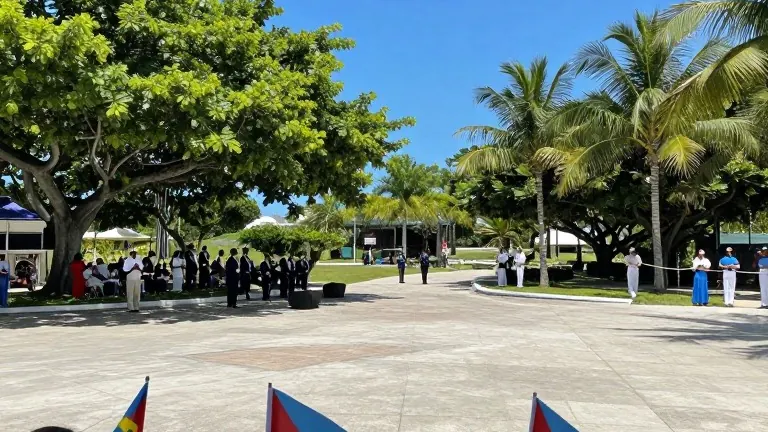
The trip marks his first official visit to the island nation since becoming king. The government closed public schools on New Providence Island to prepare for his arrival. Police and armed forces formed a ceremonial guard, with some members wearing pith helmets. The king wore a light gray suit and sunglasses as he greeted Governor General Dame Cynthia A. Pratt and Prime Minister Philip Davis.
Tensions surfaced immediately upon his arrival at Clifford Park. The site holds historical weight as the location where Charles granted independence in 1973. Members of the Rastafarian community and other protesters gathered on a nearby road. One woman shouted that the monarchy owed the people for historical atrocities. In contrast, a cheering crowd of students waved Bahamian flags inside the park for a cultural event featuring local music and performances.
Addressing the crowds, Charles acknowledged the duality of the island's history. He stated that much of Bahamian culture was born out of darkness. He argued it was right to recognize past suffering while celebrating current success. The British government has consistently rejected demands for a formal apology or financial reparations. However, Jamaica recently sent its case to the United Kingdom’s highest court for the Caribbean, adding legal pressure to the political debate.
Environmental concerns also shape the itinerary. Charles is expected to visit a nature site and meet with defense and civil society leaders. Some locals hope the visit will spotlight a dispute over development on Sampson Cay, part of the Exuma cays. Eric Carey, former executive director of the Bahamas National Trust, described the proposed project as ill advised and out of scale. He noted the plan involves a massive sea wall and the dredging of sea grass and coral reefs. Carey emphasized that the opposition is not against development but against its scale on a small island. The Bahamas Supreme Court is currently reviewing the case.
Carey expressed hope that the king will raise awareness of the issue, citing Charles's long history of defending the environment. The monarch highlighted the vulnerability of the region during his speech. He noted that 90 percent of the land in the Bahamas sits below two meters. He described the island nation as an ideal place to understand the reality of climate change.
Charles plans to stay in the Bahamas for three days. He will depart for Guyana on October 29, where the president has also requested an apology. His final stop is Antigua and Barbuda on October 30 for the Commonwealth Heads of Government Meeting. Queen Camilla will join him for the summit, where discussions are expected to cover climate, trade, and development, though some leaders insist reparations must dominate the agenda.
Source: KSAT-TV