Colombia sends troops to border city Cúcuta to stop violence
President Abelardo De la Espriella ordered the immediate militarization of the city following a week of attacks, including the killing of a former government official.
By Yuki Kaminski ·
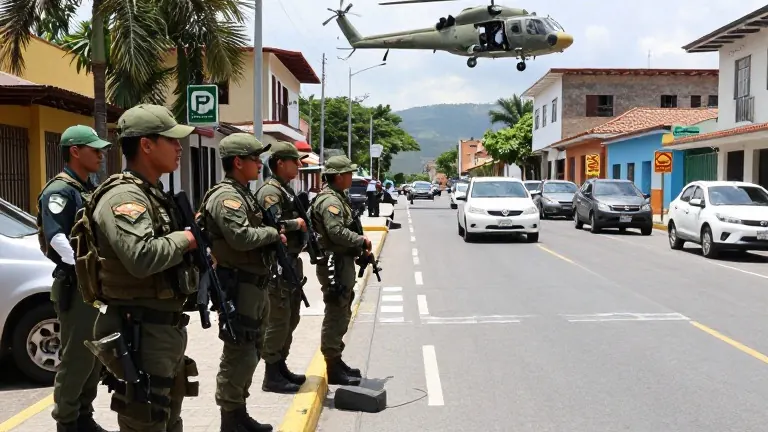
Soldiers in urban special forces units now patrol the streets of Cúcuta, Colombia, armed with long guns. They stand alongside police at traffic checkpoints while the Air Force conducts aerial surveillance. This change in the city's daily rhythm follows a presidential order issued on Thursday to contain a surge in violence along the porous border with Venezuela.
The military deployment is set to expand in the coming days. The city hall announced that 324 additional soldiers and 150 police officers will arrive to reinforce the current presence. Major General José Soto Sánchez, the army commander, confirmed the operations on social media. He noted that the forces are working to stabilize public order in the northeastern city.
President Abelardo De la Espriella, a conservative, gave the order for the immediate and temporary militarization. He cited the need to restore stability after two major violent incidents this week. On Monday, Miguel Castellanos, the former government secretary of Cúcuta, was shot and killed at a service station. Authorities are still investigating the motive and the people responsible for the assassination.
Just one day after Castellanos died, a bomb exploded near the international bridge connecting Cúcuta to the Venezuelan town of Ureña. At least four police officers were injured in the blast. Officials suspect the guerrilla group National Liberation Army, or ELN, carried out the attack, though the group has not claimed responsibility. The ELN is considered the last active guerrilla force in the country.
Cúcuta, the capital of Norte de Santander department, has long been a target for criminal groups. These organizations use multiple illegal crossings to traffic contraband, drugs, and migrants. The city borders the turbulent Catatumbo region, where armed confrontations are common in rural areas. At least two violent actors fight for control there: the ELN and a faction of FARC dissidents who did not join the 2016 peace process.
The conflict between these groups began in January 2025 over control of strategic territory with coca plantations, the raw material for cocaine. This clash has resulted in more than 100 deaths and displaced over 56,000 people, marking the largest displacement event in recent years. Gerson Arias, an analyst at the Ideas for Peace Foundation, told the Associated Press that the conflict dynamics from Catatumbo have recently moved into Cúcuta. He explained that both illegal groups use about 20 criminal bands in the metropolitan area to attack each other.
Mayor Jorge Enrique Acevedo asked on Friday for Venezuela to be included in the Shield of the Americas, a US-led alliance aimed at fighting drug trafficking. He wants this inclusion to strengthen cooperation and prevent criminal structures from taking refuge across the border. President De la Espriella stated that the militarization is necessary to guarantee security and sovereignty in a border city. He did not mention direct coordination with Venezuela. Arias noted that after the United States deposed and captured President Nicolás Maduro in January, stronger border controls were expected. Instead, bands on both sides of the border found an opportunity to continue their illegal businesses.
Source: Pioneer Press