Bomb threats disrupt commercial flights across Europe, forcing diversions and high-alert landings
At least a dozen commercial flights in eight European countries made unscheduled or high-alert landings on Thursday after a fresh wave of bomb threats, though authorities reported no initial signs of genuine danger.
By Yuki Kaminski ·
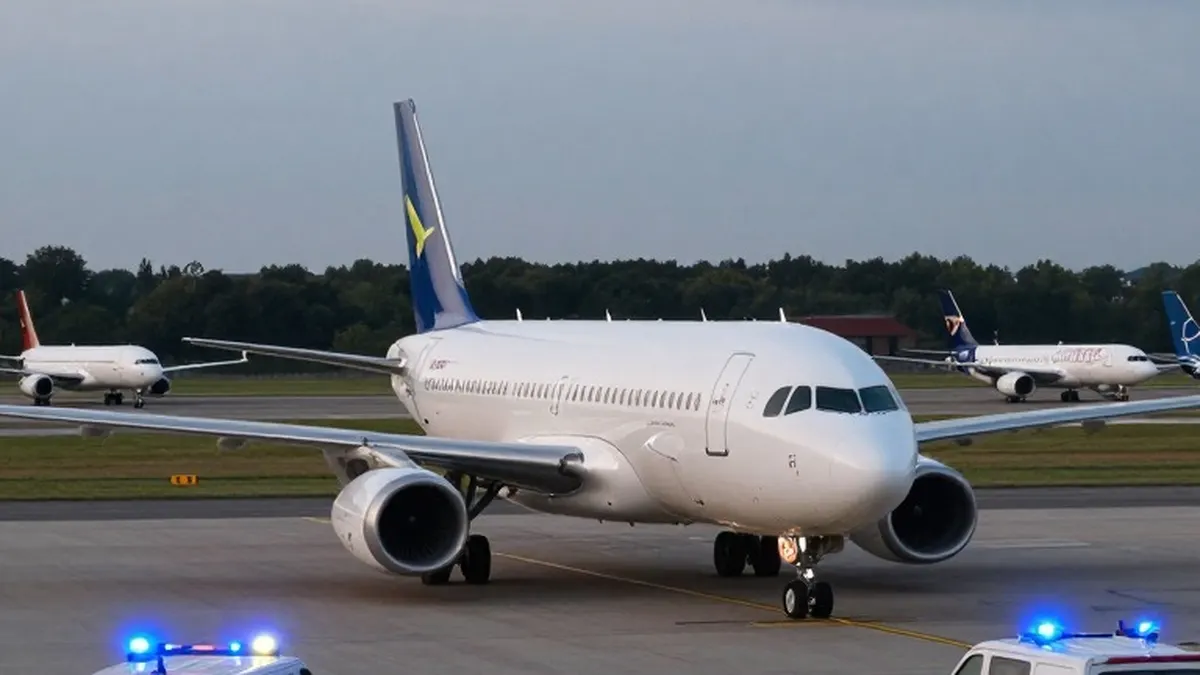
A wave of bomb threats targeting commercial aviation disrupted air travel across Europe on Thursday, with at least a dozen flights making unscheduled or high-alert landings in Austria, France, Italy, Belgium, Czechia, Spain, Serbia and Bulgaria, according to authorities in the affected countries.
The disruptions began coming to light late in the morning and continued into the afternoon. The first incident to become public involved an Aer Lingus Airbus A320 traveling from Dublin to Rome, which was diverted to the Evreux airbase west of Paris. The office of French Prime Minister Sebastien Lecornu said it was monitoring the situation "in real time," and France's air force said it dispatched planes "as soon as the incident was reported." The aircraft landed safely at the airfield after being escorted there.
Elsewhere, planes made unscheduled landings in Vienna and in Bulgaria, while a Finnair flight from Helsinki reached Rome as scheduled but under military escort. Another plane from the Finnish capital, operated by Jettime, landed in Vienna on schedule, and a Wizz Air flight from Milan to Warsaw made an unscheduled landing in the Austrian capital. Finnair said two of its planes reached their scheduled destinations amid security scares.
Bulgaria reported three aircraft making emergency landings because of bomb threats. Three Ryanair flights bound for Sofia, departing from Copenhagen, Madrid and London Stansted, all landed under high alert, with two touching down in Sofia as planned and one diverting to Plovdiv, the airport's CEO said. In Italy, an Aegean Airlines flight from Thessaloniki and a Ryanair flight from Porto landed as scheduled at Milan's Malpensa airport after receiving bomb alerts on Thursday morning, Italian news outlets and Reuters reported, citing airport sources.
Police in Madrid said three flights at the Spanish capital's airport were affected by what they described as hoax threats, adding that security forces searched the area and ruled out any risk. In the Czech Republic, police said officials at Prague airport were preparing for four landings after threats that improvised explosive devices were on board. "We assess the relevance of the threats as low," Czech police said. "Nevertheless, we do not underestimate the threat, which is why all necessary security measures have been activated with the least possible impact on passengers and airport operations." On Thursday afternoon, Air Serbia said a flight from Belgrade to Bucharest landed safely at its destination after receiving a bomb threat.
The European Union's Commissioner for Transport and Tourism, Apostolos Tzitzikostas, wrote online that any threats against civilians were unacceptable. "It is too early to draw conclusions on whether the reported incidents are linked," he said. "National investigations remain ongoing."
The alerts came two days after a similar series of bomb threats against European flights prompted unscheduled landings and major security mobilizations. Those threats, which targeted airlines including Poland's LOT, Scandinavian Airlines, Wizz Air and Ryanair, turned out to be hoaxes, and in one case the Italian air force escorted a plane to its emergency landing. Preliminary information showed no sign of dangerous materials in Thursday's threats either.
While it remains unclear whether the incidents are connected, the aviation disruptions coincided this week with a series of apparent cyberattacks targeting freezer units in major supermarkets and even French blood banks. All of the cases are still at an early stage, but they carry the potential hallmarks of so-called hybrid attacks designed to cause maximum disruption with minimal effort and resources.